

Features & Pinout
While the layout of the board is designed to stack with a Moteino, there are only a few required pins to use the WeatherShield. In fact you could get by with only 4 pins if you wanted to use the board with another type of arduino: GND, 3.3v, SCL and SDA.
The BME280 sensor is wired to use the default I2C interface with the default 0x77 address.
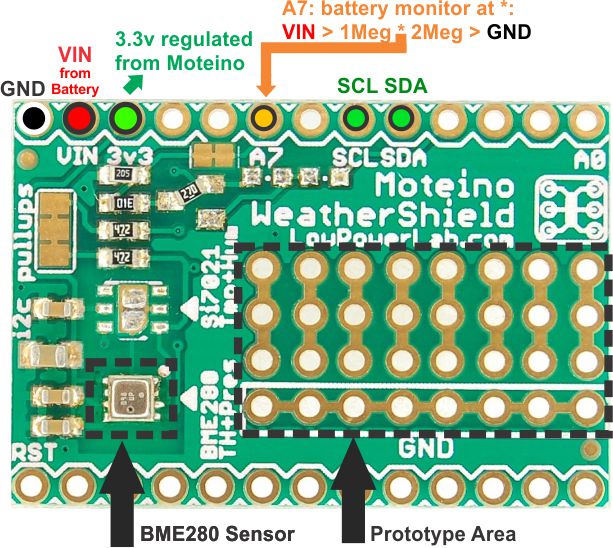
Battery/VIN monitor
The VIN pin is used in a voltage divider that is then fed to A7 on the Moteino, which can then read this value and estimate the battery or VIN voltage.
Disabling the VIN monitor
The monitor is permanently wired to VIN and at 5V will drain about 1.6uA. This is a very small amount of current and the previous revision included a mosfet to disable the monitor when not in use, in fact the pads are still there to support it but a jumper was placed instead to permanently enable it (the angled resistor). If you do not want to use this monitor and need to save that extra tiny amount of current you can do so by cutting the trace below, or if you’re brave enough, you may desolder the angled resistor and solder a SOT23-3 P-mosfet which has its gate wired to A3.

I2C interface
Note that SCL and SDA are pulled up with 4.7K resistors. The left side of the board has SMD jumpers which you can break to disable these resistors or use different values, but the default values should always work. If you have other I2C
BME280 Specifications

For more detailed specifications see the manufacturer BME280 datasheet.
Also check out this extensive comparison between BME280 and many other temperature/humidity sensors, the conclusion being that the BME280 is the clear winner among the tested devices.